‘Be water, my friend’: towards a proficiency of uncertainty by Belen Palacios

10807703874_76b665c46c_z

I have recently become a Graduate Learning Facilitator in the Design Department. As I make the overlap from a learner to a teacher, I realise that I am not just a graduate in ‘Design’, but a graduate in ‘Uncertainty’.

Initially this course makes you doubt yourself, to avoid designing by mirroring the self. You must forget what everyone told you design is, in order to start defining what you think design should be. Your first year isn’t only about emancipation, independence and taking responsibility; as uncomfortable as it it, this first year is about re-shaping your perspective.

The course then makes you doubt your surroundings. At this point you question what your role is in the socio-cultural complexity of the world (yes, the world). By then you would have gotten used to the uncertainty. You live through your questioning mindset. That is the strategy: no stability. You are in a constant state of uncertainty, and you learn to understand and accept it.

After this process, there is no ‘default designer’ expected of you. The expectations are that you perform beyond your potential. Rather than climbing the tiers of academia, your eyes open to the fact that the toolkit and ability of your BA needn’t be lesser than those of a more specialised qualification. The borders melt away between graphics, interaction, product, architecture, fashion… Instead, you learn to analyse and attack any situation, because you no longer have a default safe zone. You learn to adapt. “Be water, my friend.”

Graduates worry that they have no discipline to fit vacancy requirements. It doesn’t matter how many Adobe applications you master because you are proficient in uncertainty. Your skills are your strength against a frightening brief; your infatigable fight to reveal the un-seen; your bravery to question what is taken for granted. You aren’t against the design industry, you are what the design industry should be wishing for.
Belen Palacios

Meet Andrew Denholm, MA in Design: Critical Practice student

Let’s start the new year with the last of our interviews with new MA students on their first term at Goldsmiths. Today, we meet Andrew Denholm, who is on the MA in Design: Critical Practice: 

photo(2)

What is your background? What did you do before studying here?

I studied Illustration at Edinburgh College of Art for 4 years. After graduating i have worked as a freelance illustrator and designer. I worked on lots of different projects from magazine illustrations to packaging designs. If you are interested in my work check it out at https://www.facebook.com/andrewdenholmillustration.

Why did you choose Goldsmiths and why this particular course?

I wanted to go to Goldsmiths as i had visited the university and seen the fantastic facilities they have. I also had been to a graduation exhibition and seen the amazing work coming out of the school. The design department had some great courses but the Critical Practice course in particular was what gained my interest. It allows me to do lots of reading and learning while also getting to make new designs in the workshop. I found this to be a good balance for a designer.

How are you feeling about your choice now? What are your expectations for what’s to come?

I am really enjoying the course so far. It has been a huge learning curve but i feel that it is all very relevant and interesting. I hope to learn more computer software and start to get more hands on with making. The models we have chosen for next year will be really good.

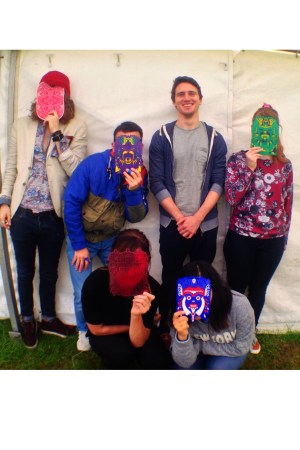
What’s the story of your photo from the day of the MA Intro?

The photo shows my group holding up the laser cut masks i made. I put them up around town as street art so i thought they would be a good object to represent what i was doing at the moment as a designer.

MA Interaction Design show: Anuradha Reddy- “Algo News”

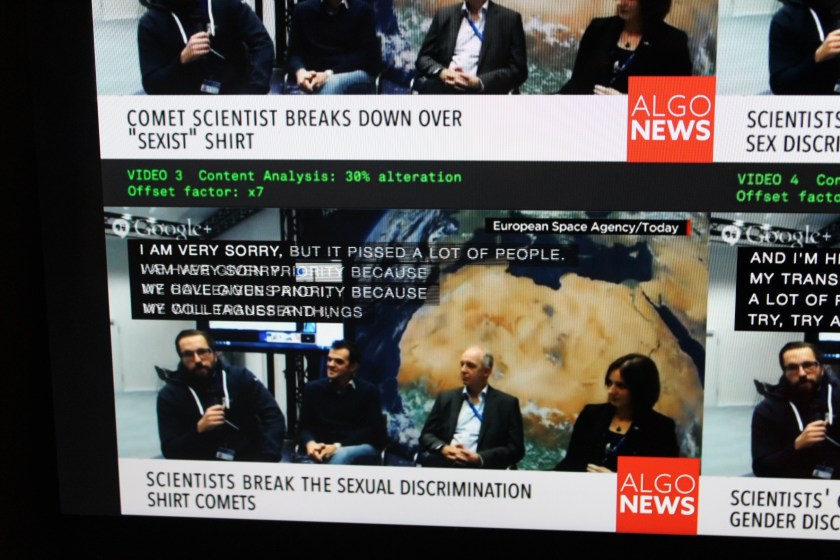
The last of our interviews from the MA in Interaction Design show features Anuradha Reddy, who was previously featured on the blog with her work for the “NOT THIS” MA show in September. At the MA Interaction Design graduation show, Anuradha exhibited the project “Algo News”:

IMG_1280

My project is about how machines can process and understand data in various ways and develop multiple interpretations of it. It explores one particular type of data: news media. The news content is mistranslated by an algorithm, and each news item is converted into about 10 different news stories based on the original story.
For example, if the original news story says: “I’m extremely sorry”, the tenth mistranslation may be “I’m extremely happy”. It seems like the machines may have some sort of thought- it makes you think about what they actually understand from your data, and it starts opening conversations about machine learning. Continue reading “MA Interaction Design show: Anuradha Reddy- “Algo News””

MA Interaction Design show: Eric Schneider- “Sustainable practices and 3D printing”

Today we feature another project from the MA Interaction Design show: “Sustainable Practices and 3D Printing”, by Eric Schneider, who proposes turning plastic waste into filament for 3D printers:

IMG_1286

My project is about supporting sustainability in a homeless community in Austin, Texas, and re-establishing the realities around 3D printing- seeing it not as replication, but as creating connections and allowing scavenging and recycling. The community I engage with is very much into sustainability, they mow the lawn with rabbits, which fertilise the lawn with their droppings, and when they are done with the rabbits, they kill them and eat them. They have a garden where they grow luffa plants which they open up, dry and use as a sponge to bathe. So I took this idea of sustainability within the community, and then I created a process where plastic waste has been ground down, melted and extruded, using workout machines to grind down the plastics. It creates a full circle sustainable system where plastic is consumed and then re-used within the community. I envisioned two products that they could potentially make in this way: one was a water collection system, where the connections between the pipes are 3D printed, so pipes that wouldn’t normally fit, do fit now. The other one was the base of a shoe. Continue reading “MA Interaction Design show: Eric Schneider- “Sustainable practices and 3D printing””