Kickstarter campaign for smart doorbell Ding, created by former Goldsmiths Design tutors

Isn’t it annoying when you’re expecting a guest or a package, but you don’t hear the doorbell, so the visitor ends up waiting outside your door for ages? If you’ve had this problem too, Ding may be just what you need: a smart doorbell that connects to an app on your phone and allows you to talk to the person standing at your door, no matter where you are.

Ding was thought up by Avril O’Neill and John Nussey, both former tutors at Goldsmiths Design. Avril is also an alumna of our BA Design programme (read an interview with her on the Design blog). The initial concept was developed at Design Council Spark, but now it’s really taking off, and by contributing to it on Kickstarter you can be a part of it, too, and get a Ding for your own home. More details on how the product works can be found on the campaign page, which is open until November 10.

Goldsmiths Design’s Alex Wilkie to be discussant at “Critical Pluralism” lecture with Professor Steven D. Brown

“Critical Pluralism’: False Memories and Real Epistemic Problems
Professor Steven D. Brown (University of Leicester)

Discussant: Dr Alex Wilkie (Goldsmiths)

When: 10th November 2016 , 4.30-6.30pm

Where: Goldsmiths, University of London, Richard Hoggart Building room 144

The term ‘false memory’ has a complex history. Initially coined as political term by social actors aiming to deconstruct the idea of ‘recovered memories’, it eventually became the object of a laboratory based field of academic ‘false memory studies’. To speak of ‘false memories’ is to be drawn into an ‘ecology of practices’ (Stengers, 1995) and multiple sets of lateral comparisons (Gad & Bruun Jensen, 2016) which resist any ready synthesis or overview. In this talk I will navigate this field by exploring how procedures of verification and falsification in relation to memory become translated between different settings and practices, in particular those of the laboratory, the courtroom and the clinic. I argue that remembering itself cannot be displaced from its radical ‘setting-specificity’ (Brown & Reavey, 2015) – our memories ‘belong’ to the practices in which they are articulated and evaluated. False memory studies – along with many other applications of psychological knowledge – produce ‘Psychologically Modified Experiences’ (PMEs). This open up an ethical and epistemic debate around the responsibility of psychologists for ‘feral’ PMEs which are at large in the broader contemporary ‘experience ecology’.

This lecture is the first in the Pluralistic Variations series, organised by the Unit of Play in the Sociology Department at Goldsmiths. The series will aim to explore, in a transversal and experimental form, the wide variety of modes of pluralistic thinking and practices that are resurfacing across an impressive range of fields, disciplines and experiences. Bringing together an transdisciplinary range of distinguished scholars, from social psychology and anthropology, to philosophy and theology, this lecture series will explore multiple and situated forms of thinking, doing, researching and feeling in a pluralistic world.

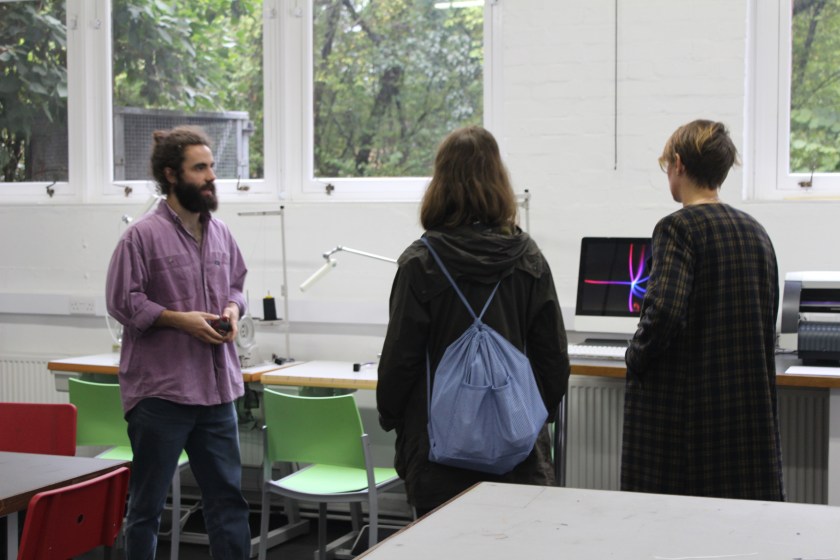
Prospective students were introduced to Design at Goldsmiths at last week’s Undergraduate Open Day

What’s it like to be a Design student at Goldsmiths? What can you expect from the course and the campus facilities? This past Saturday, 8 October, was a good day to find out, as Goldsmiths welcomed prospective students and their families for an Undergraduate Open Day.

Technical tutor Charlie Evans gave visitors a tour of the workshop facilities

At the Design stand in the Great Hall, lecturers Juliet Sprake, Rose Sinclair and Tobie Kerridge and current BA Design student Annie Kruntcheva explained to visitors what Design at Goldsmiths is all about, answering many questions about portfolios, entry requirements, and the interdisciplinary approach of the undergraduate course. Continue reading “Prospective students were introduced to Design at Goldsmiths at last week’s Undergraduate Open Day”

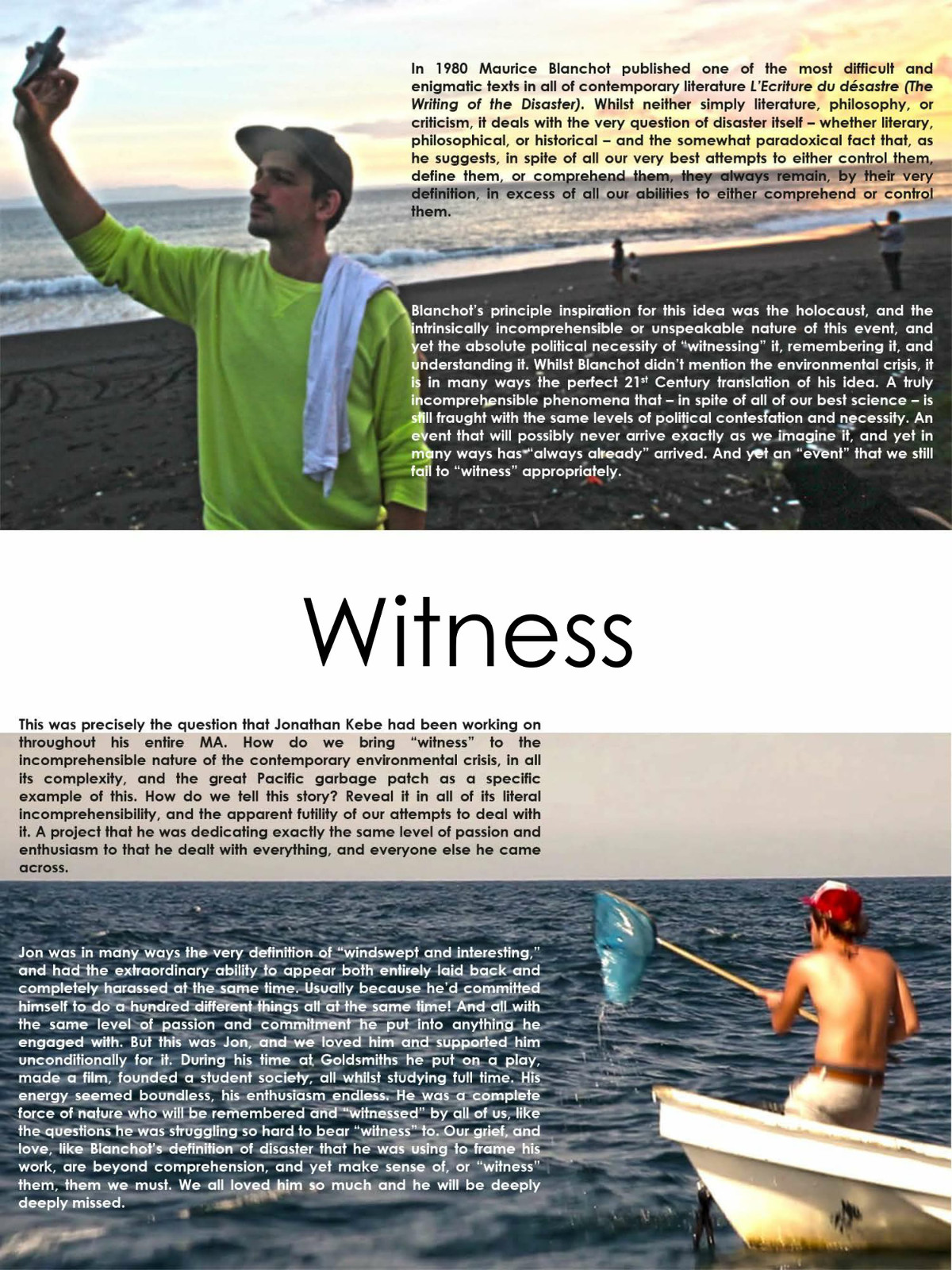
Witness: in memory of Jon

witness-1

Last week we received the sad news that Jonathan Kebe, who was studying on the MA Design and Environment programme, had died. Jonathan was a popular, active and engaged member of  both the department and Goldsmiths as a whole. His involvement across a range of projects and societies made him many friends and our thoughts are with them and, most importantly, his family. He will be missed.