‘Known Unknowns’ preview

Are you eager to find out what can you expect from the upcoming BA Design show, ‘Known Unknowns’ (opening 16 June)? You’re in luck, as a few third year students will display a preview of their work this evening, in the St James church building. All welcome! The showcase will start at 6 pm, and the exhibiting students are:

Lucy Sharpe
Dean Pankhurst
Clare Thompson
Matthew Edgson
Christian Watts
Lucre Camiletti
Lenny Terrones-Huet

All part of the BAD3 Show:

‘Known Unknowns’
The Old Truman Brewery
16th-21st June
twitter: @knownunknowns_

Masterclass for students and staff: “Doing Political Innovation with Buildings and Interventions with Buildings”

“This Wednesday, Andrés Jaque of the Office for Political Innovation (Madrid/Princeton) will deliver a Masterclass for students and staff on Doing Political Innovation with Buildings and Interventions with Buildings. This is a great opportunity for those interested in architectural and urban interventions as well as visual methods to work with an acclaimed and challenging architect.

Participants are invited to prepare for the Masterclass by reading the text Superpowers of Ten’ (click to download) and watching the videos below:

Video ‘IKEA Disobedients’ (MoMA collection)

Video COSMO MoMA PS1

If you want to come and join in the Masterclass please send an email to Carole Keegan (c.keegan[@]gold.ac.uk).

Please note: the Masterclass is first come first served with limited spaces and is being held at 10-12am in Lockwood Building room 211 (AKA the ‘Hexagon’). Andrés Jaque will also speak at the re-opening (and renaming) of C(S)ISP later in the evening together with Antoine Hennion from 5-7pm which you are warmly invited to attend too.”

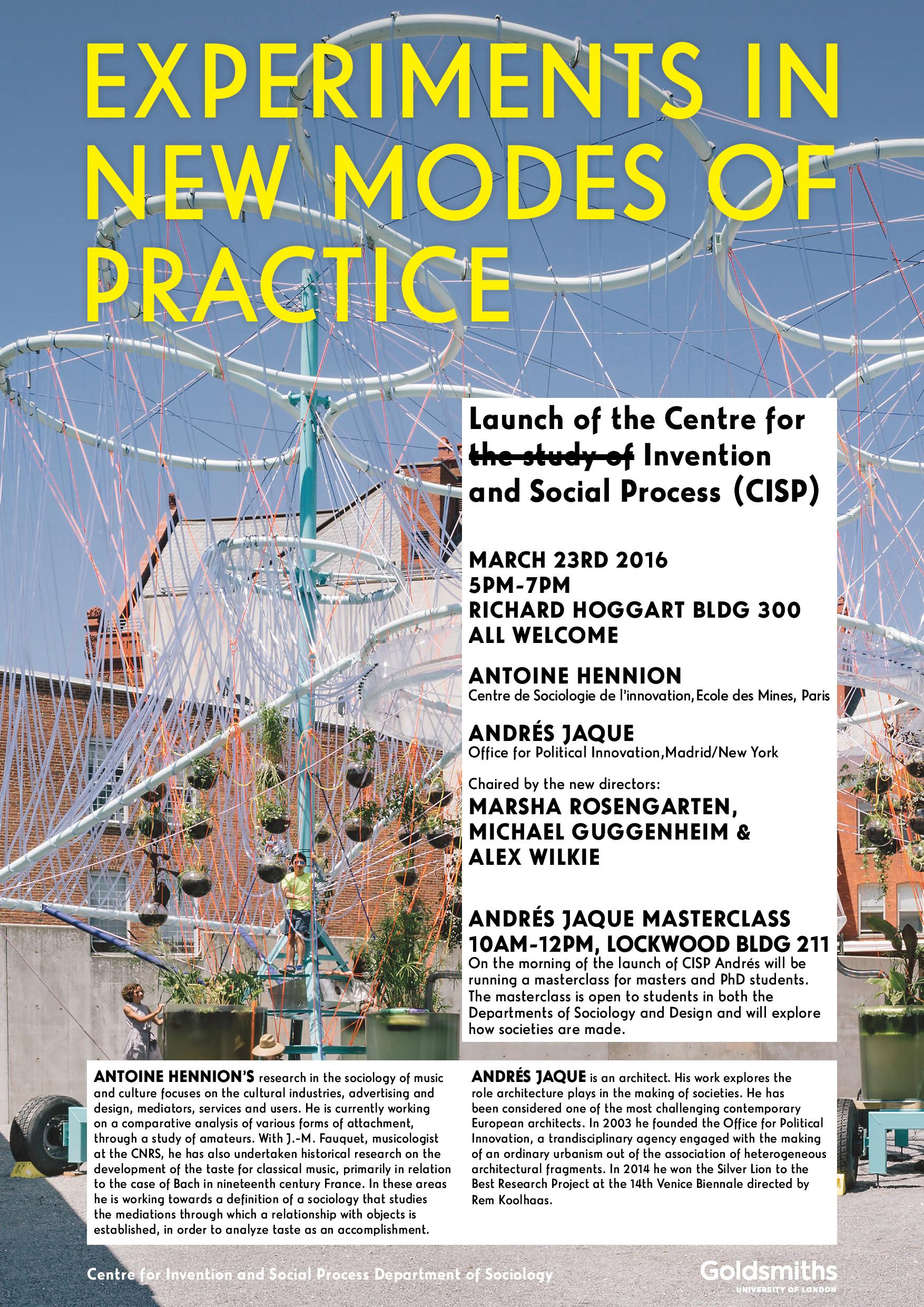
Experiments in new modes of practice: Launch of the Centre of Invention and Social Process (CISP)

“Please come and celebrate with us the relaunch of CSISP:

Experiments in new modes of practice: Launch of the Centre for the study of Invention and Social Process (CISP)

With guests Andrés Jaque, Office for Political Innovation (Madrid/New York) and Antoine Hennion (Centre de Sociologie de l’innovation, Ecole des Mines, Paris); chaired by the new directors: Marsha Rosengarten, Michael Guggenheim & Alex Wilkie

Wednesday 23rd of March 2016, 5pm-7pm, Richard Hoggart Building, Room 300. All Welcome!

Experiments in New Modes of Practice poster

Andrés Jaque is an architect. His work explores the role architecture plays in the making of societies. He has been considered one of the most challenging contemporary European architects. In 2003 he founded the Office for Political Innovation, a trandisciplinary agency engaged with the making of an ordinary urbanism out of the association of heterogeneous architectural fragments. In 2014 he won the Silver Lion to the Best Research Project at the 14th Venice Biennale directed by Rem Koolhaas. Continue reading “Experiments in new modes of practice: Launch of the Centre of Invention and Social Process (CISP)”

How To Become Modern: Time, Work and Infrastructure in Rural Newfoundland

The Centre for Invention and Social Process and the Interaction Research Studio would like to invite you to a talk with Phoebe Sengers from Cornell University, on Tuesday, 22 March. The talk will take place in Room 127 of the Richard Hoggart Building, starting 4 pm; all welcome. Here is an abstract from the speaker:

“In the 1950’s the government of Newfoundland & Labrador began an ambitious project to transform this new Canadian province from an impoverished rural backwater to an industrial economy. Central to this plan was the organized movement of most of its population from isolated fishing villages to centralized settlements allowing easier access to services and infrastructures. Change Islands was one of a few villages that actively resisted this move and insisted instead on modernizing in place. Within a few years, the village was overrun with unfamiliar technologies, including electricity, telephone, television, cars, roads, and running water.

I will use the case of Change Islands to explore how modern ways of being are shaped, sometimes accidentally and sometimes intentionally, through the design of technological infrastructures and centralized forms of governance. Modernization both relies on and produces new cognitive habits, orientations to labor, experiences of time, requirements for accountability, and moral norms, many of which do not match well to the geographical and social requirements of remote, rural communities. Caught up in contradictions, Change Islands is today simultaneously experienced as a dying relic, as a cherished preserve for traditional practices, and as unrecognizably modernized.  Change Islands is a place to recognize and reflect on the hopes invested in becoming modern, the technical mechanisms used to realize those hopes, their consequences, and their political stakes.”

Phoebe Sengers is an Associate Professor at Cornell University in Science & Technology Studies and Information Science, and is currently a Visiting Scholar in Media Studies at the University of Amsterdam. Her work integrates technology design with cultural studies of technology by analyzing the political and social implications of current technologies and designing new technologies based on other alternatives. She has received a US National Science Foundation (NSF) CAREER award, been a Fulbright Fellow and a fellow of the Cornell Society for the Humanities, had 7 major NSF grants, and led the Cornell campus of the Intel Science & Technology Center for Social Computing. She received an interdisciplinary PhD in Artificial Intelligence and Cultural Theory in 1998 from Carnegie Mellon University.

file-page1