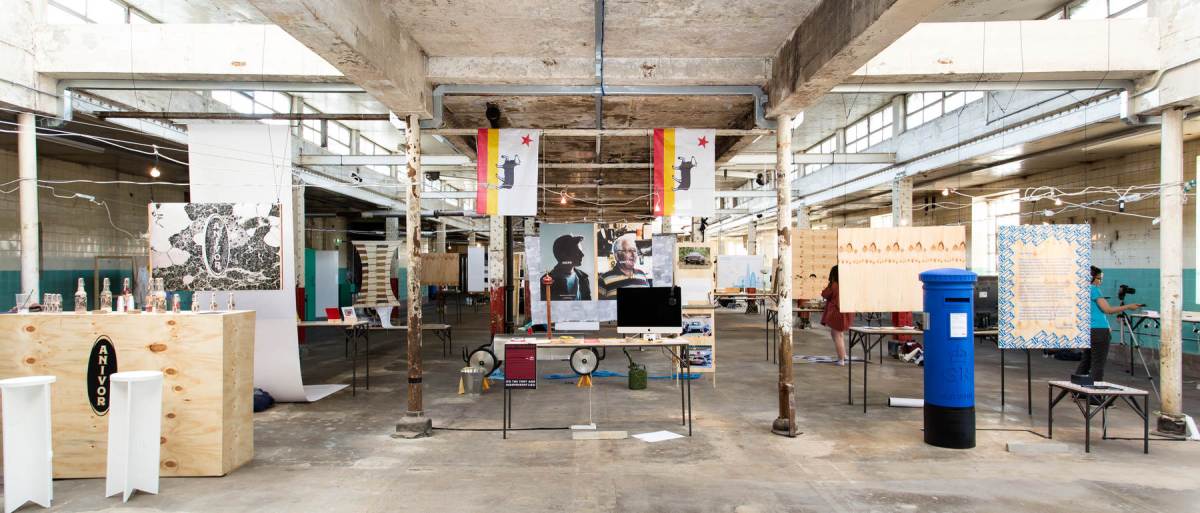
Music, catbots, saliva beer at the Goldsmiths BA Design show Hyphen

Last week, the BA Design class of 2017 exhibited their graduation work at the Truman Brewery. The show, called Hyphen, brought together a wide range of innovative projects, exploring themes from technology to our relationship with nature, from social issues to surprising twists on everyday items.

The exhibition included a number of live presentations, such as a cello performance for Imogen Piper’s project which turns data on airstrikes in Syria into music.

A couple of the graduation projects have already attracted attention from the press. Sydney Schaefer’s alcoholic drinks brewed with the help of her own saliva were featured in The Times; the development of Leah Thompson’s cat-inspired robots made an appearance on BBC One.

You can find more photos of the exhibition on our Facebook page. Videos and interviews with graduates will be coming soon to the Design blog.

BA Design graduation project in The Times

While the 2017 BA Design show HYPHEN is still open, one of the projects has already made an appearance in the press. Sydney Schaefer used her own saliva as a fermentation agent for a range of alcoholic drinks. Today, Sydney’s project was featured in The Times:

For the perfect pina colada take some chilled pineapple juice and mix it with the freshest coconut. Add a little Malibu and sugar and stir. Then, of course, finish off with lashings of fermented human saliva.

Brick Lane in London is used to serving trendy drinks to the East End’s novelty-hungry hipsters. Few will have tasted a drink quite as novel as this.

As part of her end-of-degree art show Sydney Schaefer, 23, from Goldsmiths, University of London, has harnessed the amylase enzymes in her own saliva to produce alcohol for a project exploring other uses for things humans make naturally.

Building the Cinematic: exhibition by BA Design graduate Matthew Edgson

2016 BA Design graduate Matthew Edgson will participate in the London Festival of Architecture with his exhibition “Building the Cinematic”, an expansion of his graduation project from Goldsmiths:

“Cinema is shamelessly anthropocentric.

Cinema is absorbed with human centred narrative.

Architecture must reassert itself in this realm, reverse this paradigm and bend cinema to its will the way it does with people.”

Building the Cinematic seeks to establish a form of architecturally dependent cinema. Through the creation of a series of architecturally dependent camera (& equipment) rigs, films and other materials, the fabric of architecture becomes an active element in the cinematic production process. The project proposes a shift away from apparatus such as tripods, cranes and dollies, in favour of equipment which allows for alternative interactions with the built environment and a reevaluation of the architecture we think we understand through the process of filmmaking. Architecture becomes the tripod. It seeks to express the totality of architectural space on film as opposed to a flat entity.

Building the Cinematic comes to the London Festival of Architecture exhibiting some new camera rigs, films and graphical materials which expand the thesis and framework of the project. Amongst this will be proposals created in collaboration with architects focused around the site of the Southbank Centre, exploring how architecture and film practices can intersect to produce truly architecturally dependent films.”

The exhibition will be open 13-14 June at The Nines in London.

First year students’ work on display in the studios

This week, first year BA Design students exhibited their end-of-year projects in the studios. The work was interesting and wide-ranging, tackling everything from urban foxes to goat’s cheese, from popcorn bag holders to afternoon tea in a dodecahedronic tea room, from beauty standards to political manifestos, from air pollution to imagining the future.

More photos of the exhibition can be found on our Facebook page.